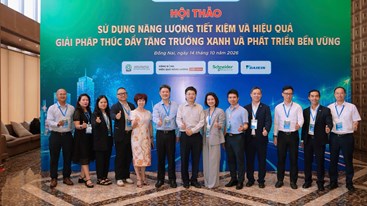
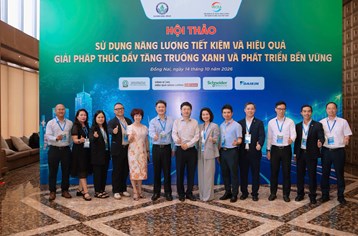
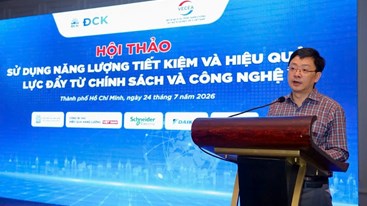
Speaking at the workshop, Mr. Lai Duc Tuan, Deputy Head of the Energy Efficiency and Green Transition Department, Agency of Innovation, Green Transition and Industry Promotion (Ministry of Industry and Trade), stated that the workshop focuses on discussing solutions for integrating renewable energy, new energy, technological innovation, and equipment upgrades to reduce energy consumption. The workshop is expected to clarify existing barriers and open new, practical pathways for the business community in promoting energy efficiency and green transition.
Mr. Lai Duc Tuan, Deputy Head of the Energy Efficiency and Green Transition Department, Agency of Innovation, Green Transition and Industry Promotion (Ministry of Industry and Trade), delivered the opening remarks.
In particular, the workshop concentrates on the role of Green Transition—an important focus in the strategic directions that the Party and Government have emphasized recently, including innovation and green transition. Energy efficiency serves as the first and foundational step toward a comprehensive Green Transition, helping reduce dependence on fossil fuels and enabling the development and integration of renewable and clean energy sources. This approach helps Vietnamese businesses enhance competitiveness and participate more deeply in global green supply chains.
“With the participation of reputable experts, policymakers, and business representatives, the workshop serves as an effective forum for discussion and knowledge-sharing, thereby opening up optimal and feasible solutions for the coming period,” Mr. Tuan emphasized.
Energy experts and Industrial enterprises participate in the Workshop on “Solutions to Promote Energy Efficiency and Green Transition”.
At the workshop, Dr. Le Hai Hung – Head of the Institute for Technology Research and Application – said that energy transition is not only about changing the way electricity is generated; it is a comprehensive shift in how energy is used across all sectors of production and daily life. There are three types of energy transitions beyond electricity generation: Firstly, replacing input fuels that are not fossil fuels: Using biomass to replace coal and FO oil in industrial boilers; Using biofuels (E5, E10 gasoline, B5, B10 oil) in transportation, agriculture, and power generation; Secondly, electrifying energy-using sectors: Shifting in transportation, motorbikes, and electric cars to replace gasoline and diesel vehicles; Replacing agricultural and construction machinery that runs on oil with electric ones; Replacing coal and oil furnaces with induction, resistance, and microwave furnaces...; Thirdly, using high-energy efficiency equipment: Electric stoves and induction cookers instead of coal and gas stoves in cooking; Heat pumps instead of cooling or heating systems; Replacing traditional lights with LED lights.

Dr. Le Hai Hung – Head of the Institute for Technology Research and Application.
Dr. Le Hai Hung emphasized: “To achieve Net Zero, energy transition alone is not enough; behavioral change in energy use is required across all sectors. This includes practicing energy efficiency through technological advancements, as well as expanding carbon sinks by planting forests and preventing deforestation, and using biomass instead of fossil fuels.”
Sharing solutions for integrating renewable energy, particularly rooftop solar, Mr. Nguyen Trung Anh, Northern Director of Nami Solar Energy JSC, emphasized Vietnam’s natural advantages with abundant year-round sunlight. Average annual sunshine hours range from about 1,500 hours in the Red River Delta to 2,700 hours in the South Central Coast. Solar energy density varies between 3,000 and 5,000 kcal/m² per day. Preliminary statistics show Vietnam’s technical solar power potential is approximately 963 GW, including: 837.4 GW from ground-mounted solar; 77.4 GW from floating solar; 48.2 GW from rooftop solar.
Mr. Nguyen Trung Anh, Northern Director of Nami Solar Energy JSC.
According to Mr. Trung Anh, rooftop solar (RTS) offers significant advantages: Technical benefits: Supports peak load reduction for the national grid (for grid-connected RTS); Reduces pressure on the grid, especially during dry seasons in the North; Helps cool buildings and protects the environment by using clean, infinite energy; Grid-connected RTS reduces investment pressure on local grid infrastructure; Self-consumption RTS improves reliability without requiring additional reserve capacity.
On the side of economic benefits, rooftop solar will help to: Reduce monthly electricity bills, especially during peak pricing hours; provide businesses with “clean electricity,” improving competitiveness in export markets; and Excess electricity sold to the grid can generate additional revenue.
Sustainability benefits of rooftop solar, including: Reduces dependence on fossil fuels; Improves energy structure and strengthens energy security; Mitigates climate change and environmental impacts; Aligns with the global trend of efficient and sustainable energy use; Technology and Equipment Upgrade Solutions Toward Green Transition.
Mr. Nguyen Thanh Ha - Energy expert, RCEE-NIRAS Joint Stock Company shares about technology, solutions for renovating, upgrading equipment, and reducing energy consumption towards green transformation.
Mr. Nguyen Thanh Ha, Energy expert, stated that industrial energy efficiency solutions include: Replacing standard motors with high-efficiency IE3/IE4 motors and installing inverters; Optimizing boiler and steam systems; Installing waste heat recovery systems for power generation; Optimizing compressed air systems; and Installing energy monitoring and management systems. Specifically, Waste heat recovery and furnace optimization help steel plants reduce energy consumption by 22%; Upgrading motors and inverters helps cement plants reduce consumption by 18%; Steam system optimization and heat recovery help textile factories save 25%.
For buildings, energy efficiency can be improved by: Optimizing HVAC systems (high-efficiency chillers, heat pumps, VRF systems, smart controls); High-efficiency lighting using LEDs with sensors and smart controls; Improving the building envelope with insulation and high-performance windows; Energy monitoring and control; Using high-efficiency appliances. In which, HVAC system renovation and LED lighting replacement combined with smart control help office buildings save 32% energy; Building management system (BMS) and heat recovery system help hotels save 28% energy; Building shell, HVAC and lighting renovation help shopping malls save 35% energy.
The workshop provides information to help businesses promote energy savings and green transformation.
The workshop also included a Q&A session where delegates discussed topics related to solutions for promoting energy efficiency and green transition. Participants’ feedback aims to accelerate Vietnam’s progress toward sustainable production and consumption as part of the Green Transition process.
Innovation, Green Transition and Industry Promotion Agency (MOIT).








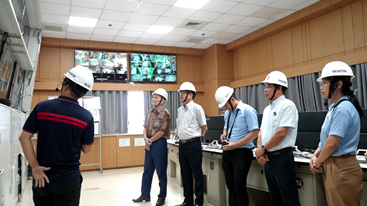 Polytex Pioneers Energy Efficiency in the Textile and Dyeing Industry
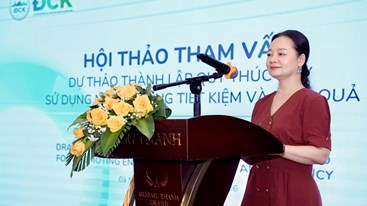 Consultation on the Draft of the Vietnam Energy Efficiency Fund Establishment
 Contract Award Notice - Review and update for current Energy Efficiency Benchmarking for 2 Sub-Industrial sectors
 Contract Award Notice - Notice for Contracts award for Finalize VNEEF (Vietnam National Energy Efficiency Fund) model (Package C2.2.14)