


Sunday, 25/10/2026 | 04:47 GMT+7

This technique has an enormous potential. Only in the United States, for instance, the total surface of roads, highways and open parking lots is estimated in over 100,000 square kilometres. The proposal comes from an American company which, using funds granted by the US Federal Highway Administration, is designing resistant photovoltaic panels on which cars can drive, with tiny prisms built into the surface in order for tyres to grip.
This technique has an enormous potential. Only in the United States, for instance, the total surface of roads, highways and open parking lots is estimated in over 100,000 square kilometres.
The proposal comes from an American company which, using funds granted by the US Federal Highway Administration, is designing resistant photovoltaic panels on which cars can drive, with tiny prisms built into the surface in order for tyres to grip.

Panels will not be only placed on roofs, now that far more
ambitious options are being studied. One of the most promising, which come from
the US company Solar Roadways and was then publicized by the esteemed New
Scientist magazine, proposes that they can be used to pave roads instead of
asphalt.
This technique has an enormous potential. Only in the United States, for instance, the total surface of roads, highways and open parking lots is estimated in over 100,000 square kilometres, equivalent to one third of Italy.
To this end, Solar Roadways, using funds from the US federal highway administration, is designing 3.7-metre (the ordinary width of US lanes) square PV panels on which cars can drive, so that they can be placed on the roads.
If one considers an average peak insulation equivalent to 4 hours a day and an energy efficiency of around 15%, each panel would produce 7.6 kWh a day.
The most obvious problem is the need to build panels that
are resistant to the pounding of cars and trucks. According to Scott Brusaw,
the electrical engineer who founded Solar Roadways, this difficulty can
nevertheless be overcome, for instance by adapting the techniques used to make
bullet-proof glass.
The second problem is that when a surface is too smooth, it cannot be used for driving. In this case the surface of panels, instead of being smooth, would have thousands of tiny prisms built into it, in order for tyres to grip.
enelgreenpower.com








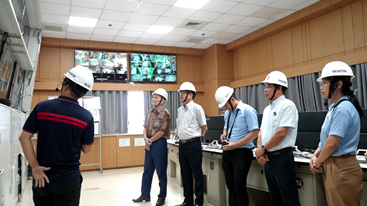 Polytex Pioneers Energy Efficiency in the Textile and Dyeing Industry
 Conference on Energy Efficiency and Conservation in 2026
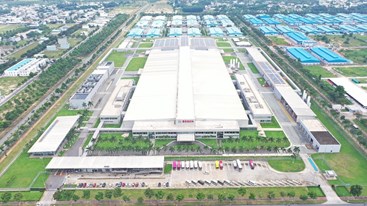 Bosch Vietnam Optimizes Energy to Advance Sustainable Manufacturing
 Consultation on the Draft of the Vietnam Energy Efficiency Fund Establishment
 Contract Award Notice - Notice for Contracts award for Finalize VNEEF (Vietnam National Energy Efficiency Fund) model (Package C2.2.14)
 Contract Award Notice - Review and update for current Energy Efficiency Benchmarking for 2 Sub-Industrial sectors
 Policies, Technology and Finance Driving Energy Efficiency in the Industrial Sector